

The series regarding methane adsorption behavior in marine-continental transitional shales is the subject of great interest in the energy arena. Learning about these features is critical in finding the ideal way to maximize the production of natural gas in the shale reservoirs and realizing the full potential of the complex plays.
Energy:
The marine-continental transitional shale has some special characteristics that interfere with the capacity of methane adsorption. The study of these properties can yield helpful information as to how shale gas behaves and hence more efficient extraction can be done.
The significance of methane adsorption in the consolidated rocks cannot be overemphasized because it directly relates to the amount of gas that is stored and released. Investigation of the factors that affect methane adsorption allows us to gain insight into the processes that play out when these interactions occur.
Key Takeaways:
- Adsorption characteristics of methane are the important aspects of shale gas production.
- Transitional marine-continental shales are peculiar.
- Knowing more about the adsorption of methane can help in more efficient extraction
- Studies on the property of shale will help unleash new potentials
The effects on the adsorption of methane is directly linked to the gas storage and release
Transitional shales can offer an interesting topic of study in geology and exploration of the forces in energy. These shales are created on the boundaries of marine and continental environments, thus they are formed under very unique geological settings where the conditions of the marine environment and the land environment meet.
Rock Formalization and worldwide occurrence:
Transitional shales form due to a number of processes, tectonic processes, eustasy, and sediment supply. These aspects make the transitional shales quite distribution in the globe with the major deposits having been found in the areas like the United States, China and Australia.
Compositional and Structural Properties:
The transitional shales also vary in their composition and structure to an extent crucial to their energy potential. Such shales are defined by their complex mineral composition that consists of mixture of clay minerals, quartz and other minerals, combined with quite an amount of organic matter.
Organic matters contents and maturities:
The content and maturity of organic matter is the most important characteristic to determine the energy potential of transitional shales. Greater organic matter and suitable maturity stages are the signs of shales that have a high hydrocarbon generation capacity.
| Characteristics | Significance | Impact on Energy Potential |
| Organic Matter Content | Indicates potential for hydrocarbon generation | Higher content = greater potential |
| Maturity Level | Determines the stage of hydrocarbon generation | Optimal maturity = higher energy potential |
| Mineral Composition | Influences shale’s mechanical properties | Affects extraction and production efficiency |
A senior geologist observes that, the shales of transitional nature are highly complex whereby their complete energy potentials are yet to be unlocked through a thorough understanding of their geological, compositional and structural characteristics. This only highlights the need to continue the study of these special structures.
Shale Formations Mechanisms of Methane Adsorption:
Recognizing how methane is adsorbed in shale rock is essential to evaluate energy potential of shales. The major determinants of adsorption process are the surface area and the micropore structure of the shale.

Ultra-High Potential and Output of Gas based on Methane rich Transitional Shales:
Methane rich transitional shales have attracted potential due to its high energy worth. Evaluation of their energy potential includes interpretation of resource assessment techniques, extraction technology and economic the feasibility of producing methane out of these shale formations.
Resource assessment methods:
Poor resource estimating is playing a critical role in ascertaining the energy potential of transitional shales that contain methane. Methods are mainly geological surveys, laboratory experiments and modeling techniques in order to provide an estimation of methane adsorption capacities and the amount of total organic carbon.
Important parameters in resource evaluation are the thickness of shale, total organic carbon (TOC) content and thermal maturity. These play a role in the adsorption capacity of methane and, by extension, the energy source capacity of the shale formation.
| Parameter | Description | Importance |
| Thickness | Thickness of the shale formation | High |
| TOC Content | Total Organic Carbon content in the shale | High |
| Thermal Maturity | Level of thermal maturity of the organic matter | High |
Recovery rates and extraction Technologies:
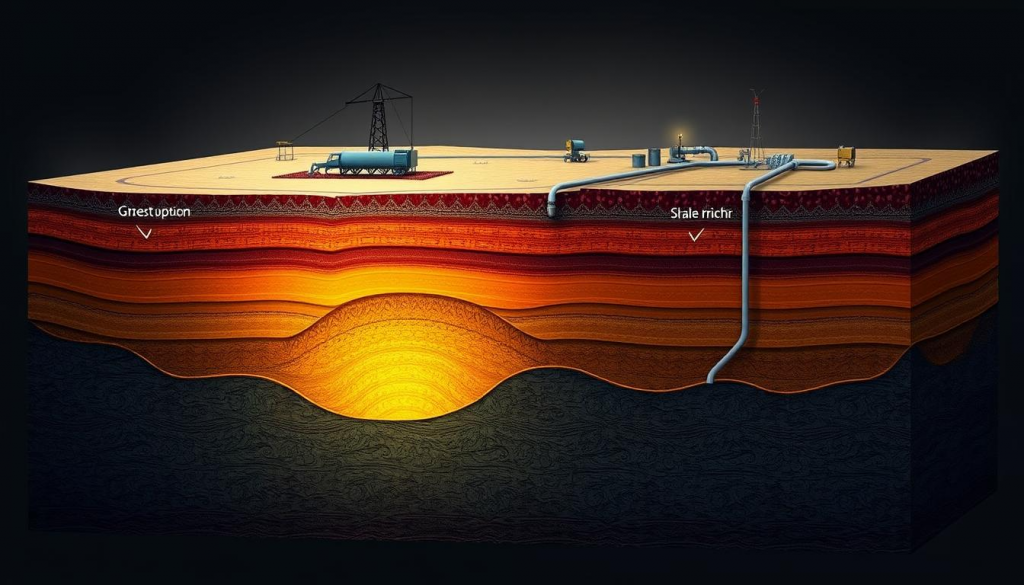
Whether it is the extraction of methane by use of transitional shales, many technologies are used such as hydraulic fracturing, shallow drilling, and even horizontal drilling. Those technologies boost the recovery levels through enlarging the contact surface with the extraction process.
Recovery rates depend on the shale permeability, the recovery efficiency of the extraction technology and the operational conditions, i.e., pressure and flow rate.
Potential of Transitional Shales between Marine and Continents Unlocked:
The study of the characteristics of methane adsorption on marine-continental transitional shales, that can help unlock their energy potential, is of great importance. It is found that the uncommon composition and structural characteristics of these shales are very important in terms of setting their methane adsorption ability, which consequently influence energy generation.
Understanding mined in these shales has the potential to direct resource estimation tools and technologies, which will result in higher recovery rates of energy. With persisting changes of the energy system, the role of these transition shales in providing future energy needs cannot be overemphasized.
Through understanding more about the processes of methane adsorption within these complicated shale structure, we will be able to utilize the available energy within them more efficiently towards a greener energy future.
FAQ:
What are the marine-continental transitional shales?
An example is the marine-continental transitional shales, a form of shale formation that bears characteristics of both the marine and the continental depositional environments and which may often occur in the parts where ancient seas and the land interacted with each other.
What influence do methane adsorption characteristics have on energy production?
Methane adsorption properties are a key factor in defining the energy potential of gas shales in that they define the level of methane available to be stored and released by the shale.
What does the content of organic matters in shale formations imply?
The content of organic matter is a key element of making a shale formation, because it determines how well shale porosity generates and entraps hydrocarbons, including methane.

