

Surprising fact: nuclear provides about 10% of the world’s electricity and roughly 20% in Europe, a share that still shapes grid resilience in 2025.
The question of this technology’s future has resurfaced as electricity demand is set to rise by more than half between 2022 and 2040. Policymakers in the UK now balance decarbonisation, affordability, and resilience.
This short report synthesises the latest UK technology news and renewable energy developments to explain why the sector matters today. It clarifies what “dominate” could mean: installed capacity, generation share, or system value through reliable, low‑carbon supply.
Drivers include reactor restarts, life extensions, new builds, and small modular reactors entering demonstration, even as construction pacing and financing remain constraints.
Readers will get an evidence‑led preview linking pipelines, cost trajectories, uranium dynamics and UK policy to realistic scenarios. The aim is a balanced, practical view for decision‑makers tracking sustainability and the wider energy transition.
Key Takeaways
- Nuclear currently supplies a meaningful share of electricity, especially in Europe.
- Faster electrification raises demand for dependable, low‑carbon generation.
- SMRs and life extensions could lift contribution, but timelines and costs vary.
- UK policy and supply chains will influence domestic siting and finance choices.
- Analysis relies on quantified pipelines, cost trends and supply‑demand data.
At a glance: the latest industry news shaping nuclear’s 2025 outlook
Recent industry updates indicate 2025 could be an inflection year. The IEA projects nearly 3% annual growth in nuclear generation through 2026, with generation hitting record highs as markets complete builds and ramp fleets.
Key headlines: technology news UK and renewable energy news UK
Operational drivers include Japanese restarts, higher output in France and new units in China, India and South Korea. Around 29 GW of additional capacity is expected online in the next few years, lifting electricity supply and system reliability.
What’s changed since last year: reactors, regulation and financing
Finance is shifting. Fourteen global banks pledged support during New York Climate Week 2024 and green bond interest is rising. Risk‑sharing models could lower the cost of capital for new builds.
Regulation is also moving: licensing for SMRs and advanced technologies advances in several jurisdictions, though timelines and resourcing remain constraints. For UK readers, these headlines tie into broader clean power strategies that pair firm generation with expanding renewables to stabilise grids and support industrial competitiveness.
- IEA growth and the 29 GW pipeline signal tangible year‑on‑year increases in generation.
- Finance pledges and evolving licences improve project viability.
- Corporate demand from AI and data centres raises interest in 24/7 clean contracts.
Where nuclear stands today in the global electricity mix
Nuclear continues to supply a reliable fraction of generation while grids add more variable renewables.
Today, nuclear provides roughly 10% of electricity worldwide and about 20% in Europe. This reflects an established role that varies by region and policy history.
Electricity demand is rising faster than total energy use. Planners therefore seek dependable low‑carbon sources to keep systems stable as wind and solar grow.
Baseline facts and system context
Key points:
- One‑tenth of world electricity and one‑fifth in Europe shows nuclear’s steady share.
- Nuclear is second only to hydropower among cumulative low‑carbon sources and helps balance intermittent generation.
- Fossil fuels still supply a majority today, but scenarios from major agencies show their share falling sharply.
“Maintaining and improving fleet performance can safeguard emissions reductions when weather‑dependent output dips.”
| Metric | Global | Europe |
|---|---|---|
| Nuclear share of electricity | ~10% | ~20% |
| Role among low‑carbon sources | 2nd after hydropower | 2nd after hydropower |
| System function | Firm baseload and reliability | Firm baseload and reliability |
Readers can consult nuclear power in the world today for fuller statistics and regional detail.
Pipeline momentum: reactors under construction, planned and proposed
A clear build-out is visible: dozens of reactors are advancing from planning to construction across many markets.
Pipeline snapshot: 61 reactors are under construction in 15 countries, with roughly half of those units located in China. Authorities and developers target 59 of these projects to be online by or before 2032, giving nearer-term visibility for capacity additions.
Beyond current builds, about 85 reactors sit in planned status and another 359 are proposed. That wider funnel shows intent, even though not all projects will reach final investment decisions or construction.
Analysts estimate roughly 200 GW of additional nuclear generating capacity by 2040. That growth comes not only from new plants but from life extensions and reactor restarts, which together supply a significant share of incremental capacity.
Supply chains and workforce demands will rise with sustained construction. Heavy manufacturing, component standardisation and experienced project management are critical to meet schedules and control costs.
“Repeat builds and standard designs reduce delivery risk, but large plant construction still carries material schedule and cost uncertainty.”
- 61 reactors under construction in 15 countries signal broad activity.
- 59 projects slated by 2032 provide near‑term additions.
- 85 planned and 359 proposed units indicate a deep intent pipeline.
- About 200 GW by 2040 driven by builds, life extensions and restarts.
For the UK, sequencing, regulatory throughput and supplier readiness will determine how domestic programmes link to this global momentum. Realistic appraisal must weigh learning‑curve gains against persistent delivery risks.
Small Modular Reactors and advanced technologies: promise, pace and price
Small modular designs aim to change how reactors are built, shifting work from site yards to factory floors. SMRs typically range from 20–300 MW versus ~1 GW for traditional reactors. Standardised, factory‑built components reduce on‑site complexity and support repeatable schedules.
Cost modelling indicates projected LCOEs could be under $100/MWh for SMRs, against roughly $125/MWh for large units, though outcomes depend on learning rates and supply chain scale.
Advanced technologies — molten salt reactors (MSRs), high‑temperature gas reactors (HTGRs) and fast reactors — are moving through demonstrations. These designs target both electricity production and industrial heat applications such as hydrogen and data centre colocations.
Only a small number of SMR units are currently licensed and operating, underlining the early deployment stage. In the UK, Rolls‑Royce SMR progress and potential 2025 investment decisions could unlock domestic capacity and exports.
“Standardised designs and passive safety features aim to shorten schedules and bolster public confidence.”
- Delivery advantage: smaller units allow phased capacity additions and new financing models.
- Safety: passive systems and inherent characteristics are central to next‑gen licensing.
- Challenges: first‑of‑a‑kind premiums, licensing throughput, and supply chain scale‑up remain.
Uranium market dynamics: supply, demand, and price risk
Uranium markets are entering a period of persistent tightness that will reshape fuel procurement choices over the next two decades. Demand for uranium oxide rises from roughly 90,000 tonnes in 2024 to about 164,000 tonnes by 2045.
Supply shows a near‑term lift: primary production grows from ~80,000 tonnes to near 95,000 tonnes by 2030, then falls to around 60,000 tonnes by 2045. That creates a forecast deficit of about 17,500 tonnes by 2030, widening to roughly 100,000 tonnes by 2045.
These structural gaps will support higher uranium prices and increase volatility for utilities. Higher fuel costs alter contract economics even though fuel is a smaller share of lifecycle costs than for gas plants.
“Persistent deficits in mined production and conversion suggest strategic hedging and longer-term contracts will be essential for secure generation.”
- Quantified gap: growing shortfall between annual fuel need and mined supply through 2045.
- Supply path: near‑term rise to 2030, then decline without fresh investment.
- Actionable steps: blend spot exposure with long‑term contracts, monitor conversion and enrichment bottlenecks, and consider recycling where feasible.
Economics and finance: capital, green bonds, and risk-sharing models
Investor sentiment has shifted, prompting novel financing structures for large low‑carbon builds. In 2024, fourteen major banks, including Bank of America and Morgan Stanley, signalled support that aligns capital markets with COP28’s capacity‑tripling ambition to 2050.
Green bonds, blended finance, and risk‑sharing mechanisms aim to reduce construction‑phase volatility and lower the cost of capital. Regulated asset base models and CfDs can smooth cash flows through long construction periods and early operation.
Bank commitments and market effects
The pledge from leading banks shifts the sector toward project finance solutions that attract pension and insurance capital. Standardised technologies and modular construction further de‑risk schedules and broaden investor pools.
Balance sheets, costs, and policy levers
Utilities face heavy capital intensity and tighter credit metrics during construction. Government guarantees, export credit, and coordination with multilateral energy agency programmes can improve bankability for first‑of‑a‑kind projects.
“Transparent ESG reporting, lifecycle emissions data, and reliable delivery records will be pivotal to qualifying projects for sustainable finance.”
- Cost of capital materially affects levelised costs and consumer prices.
- Corporate offtakes (for example, from data centres) provide long‑term revenue anchors.
- On‑time, on‑budget delivery is essential to tighten financing spreads and scale the pipeline.
| Mechanism | Benefit | UK relevance |
|---|---|---|
| Green bonds | Lower fixed‑rate capital | Attracts institutional holders |
| Regulated asset base | Predictable returns | Stable consumer pricing |
| Blended finance / guarantees | Reduce first‑of‑a‑kind risk | Supports domestic construction |
Outlook: Financial innovation plus stable policy can unlock a steadier pipeline and reduce systemic financing risk over the coming years.
Scenario analysis: IEA, IAEA, EIA, and industry outlooks compared
Scenario models paint contrasting futures for dispatchable low‑carbon generation through to 2050. Readers need a concise comparison of major agency pathways to judge implications for capacity and generation over the period.
STEPS versus NZE: policy ambition shifts the role
IEA STEPS implies modest expansion as overall energy needs rise ~21% to 2050 and electricity nearly doubles. This yields incremental increases in firm capacity.
In contrast, the IEA NZE path removes most fossil generation by 2050, requiring substantial additional low‑carbon dispatchable plants to back up variable sources.
Capacity ranges to 2050: IAEA low/high cases and regional split
The IAEA (2022) reports 371 GWe operable today, with scenarios ranging to ~458 GWe (low) and ~890 GWe (high) by 2050. Asia accounts for most of the upside, while Europe focuses on life extensions and selective new builds.
Contrasting shares: EIA and IEEJ pathways
The EIA IEO 2023 projects renewables near 50% of electricity by 2050 and a slight fall in nuclear share from ~10% to ~8% as total generation expands.
The IEEJ Outlook 2024 shows divergence: ~10% in an advanced technologies scenario versus ~7.2% in a reference case, underlining sensitivity to deployment choices.
“Analyses such as MIT’s indicate markedly higher system costs when decarbonisation proceeds without firm low‑carbon generation.”
| Model / Agency | Key outcome by 2050 | Implication for capacity vs generation |
|---|---|---|
| IEA STEPS | Modest capacity growth; electricity nearly doubles | Absolute generation rises; share may fall as renewables expand |
| IEA NZE | Major expansion of low‑carbon firm plants | High capacity additions; higher generation share for dispatchable units |
| IAEA (2022) | 371 GWe today → 458–890 GWe range | Large uncertainty; Asia concentration in high case |
| EIA IEO 2023 / IEEJ 2024 | Shares vary 7–10% depending on scenario | Share depends on total system growth and renewables uptake |
- Capacity vs generation: higher capacity does not always translate to proportional generation — capacity factors and operational performance matter.
- Period sensitivities: near‑term builds shift baselines by 2030–2040; 2050 outcomes hinge on policy, finance and supply chains.
- UK takeaway: scenarios emphasise the trade‑off between energy security, affordability and emissions in domestic planning.
Sectoral demand surges: data centres, AI, and 24/7 clean power
Hyperscale computing has reshaped regional demand, creating pockets of near‑constant electricity need around major data hubs.
Why this matters: AI training rigs and large server farms drive steep rises in local electricity consumption. Corporates now value uninterrupted, low‑carbon supply to meet science‑based targets and SLA guarantees.
Power purchase strategies and SMR siting near digital hubs
Procurement is evolving. Firms prefer long‑dated contracts that anchor firm capacity rather than only hourly certificates. These arrangements support new plants and reduce merchant risk.
Major announcements show the trend: Amazon with Dominion and X‑energy (~5 GW), Google with Kairos Power (~500 MW), Microsoft examining Three Mile Island, Meta pursuing ~4 GW, and Switch with Oklo. Such deals signal rising comfort with firm low‑carbon options.
- Demand mix: hyperscalers create continuous load profiles needing reliable power generation near sites.
- Siting benefits: SMRs colocated with digital hubs can cut transmission losses, boost resilience, and allow waste‑heat reuse for local district heating.
- Hybrid design: SMRs alongside large renewables and storage form campuses that balance variability and deliver 24/7 supply.
“Standardised, modular delivery shortens timelines and improves bankability when corporate offtakers anchor revenue.”
In the UK, digital economy growth could benefit from these models, provided regulators and communities consent to nearby siting and robust safety communication. Developers must meet planning, licensing and engagement standards before projects proceed.
For context on data‑centre trends and resilience planning, see the global data‑centre market outlook and guidance on data centre resilience.
Nuclear-enabled hydrogen and industrial heat: decarbonising hard-to-abate sectors
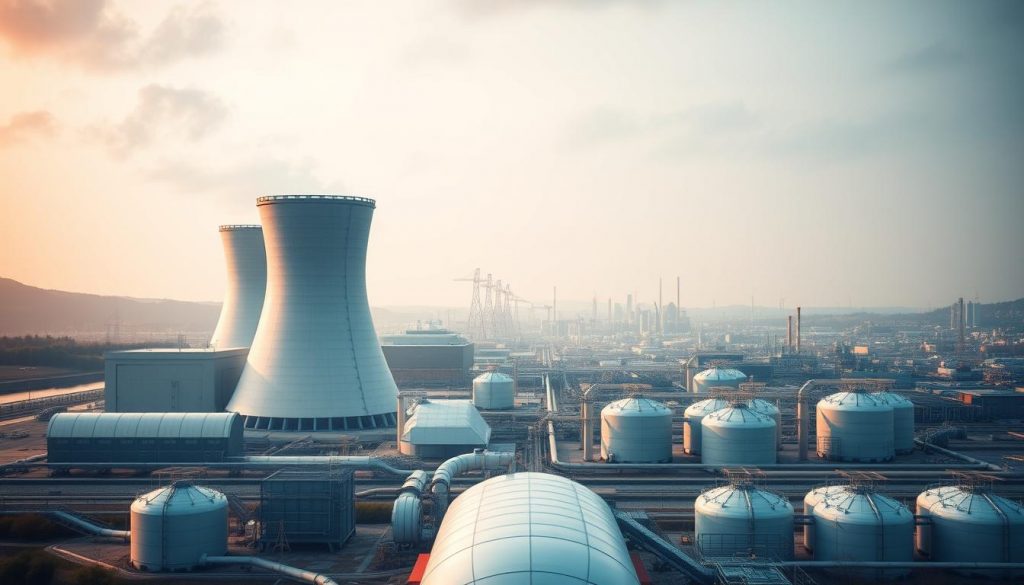
Pilots now pair reactors with electrolyser units to produce low‑carbon hydrogen at scale. These projects use reactor electricity for electrolysis and reactor heat for advanced thermochemical routes. The result is lower lifecycle carbon intensity than fossil-derived hydrogen.
Pilots, policy, and technologies
Notable demonstrations include Constellation’s Nine Mile Point in the US, EDF programmes in France and Japan’s HTTR study. Policy incentives such as US tax credits and clean hydrogen standards improve project economics and attract offtake contracts.
- Use cases: electrolysis for hydrogen production and high‑temperature heat for refining, chemicals, steel and cement.
- System value: hydrogen offers seasonal storage and a decarbonised feedstock, enhancing grid resilience.
- Barriers: regulatory clarity, transport and storage infrastructure, and bankability for early projects.
| Aspect | Benefit | UK relevance |
|---|---|---|
| Electrolysis (reactor electricity) | Low‑carbon hydrogen production | Suited to coastal clusters with existing grid links |
| High‑temperature heat | Efficient industrial processes | Reduces fuel switching costs in heavy industry |
| Policy support | Improves bankability and offtake | Tax credits and standards encourage domestic scaling |
“Early demonstrations will de‑risk supply chains and show how reactors can decarbonise industry without compromising reliability.”
United Kingdom focus: policy, projects and sustainability news UK
UK policymakers are sharpening their focus on a firm low‑carbon supply as renewables scale rapidly.
Policy priorities centre on secure, low‑carbon electricity with stable prices supported by firm capacity that complements fast renewables deployment.
Energy security, baseload needs, and grid stability considerations
Reactors provide steady baseload reliability, onsite fuel inventories, and price stability because fuel is a small share of lifetime costs.
Grid services include voltage support, inertia, and fast frequency response — services that gain value as intermittent generation expands.
“System costs rise markedly without firm low‑carbon plants in tight carbon scenarios.”
SMR siting, regulatory timelines, and supply chain readiness
SMRs are suited to siting near demand centres and industrial clusters, balancing planning consent, community benefits, and environmental checks.
Timelines run from generic design assessment to site licensing and construction permits; streamlining is possible, but it must preserve safety and scrutiny.
- Supply chain readiness needs heavy manufacturing, skilled labour, and standardised components.
- Nuclear power plant projects can anchor apprenticeships, regional jobs, and export capability for British firms.
- Financing options include regulated asset base models and green bond issuance to lower consumer costs.
Reducing reliance on fossil fuels for baseload supports emissions goals and strengthens resilience during low wind or solar output.
Transparent stakeholder engagement and international cooperation will help align technology news UK and sustainability news UK with public consent and best practice.
Regional developments to watch: Europe, Asia-Pacific, and Africa
Regional programmes now shape where and how much firm low‑carbon capacity is delivered across continents. The following scan highlights policy, construction, and training that UK stakeholders should monitor.
Europe: restarts, life extensions, and selective new builds
France is lifting output through restarts and life extensions, improving grid security while keeping climate targets on track.
Targeted projects and selective plant construction reduce short‑term supply risk and preserve system flexibility.
Asia‑Pacific: China, India, and regional execution
China continues fast construction of standardised plants, delivering large capacity additions at scale.
India’s Bharat Small Reactors initiative aims to expand domestic capacity with public‑private collaboration and factory assembly models.
Japan pursues restarts under tighter safety rules, and South Korea sustains steady programme execution and export contracts.
Africa’s acceleration: training, finance, and first‑wave projects
Ghana’s Regional Clean Energy Training Centre and South Africa’s HTMR‑100 financing progress build local capability.
Egypt’s El‑Dabaa (~30% complete by end‑2024) and Rwanda agreements mark early project momentum.
Türkiye’s Akkuyu heads into trial operations, with multi‑site plans and international partners under discussion.
Opportunities for UK engagement include skills partnerships, regulatory cooperation, and supply‑chain participation to support safe, timely delivery across these regions.
Risks, constraints, and enablers: safety, waste, public consent, and renewables integration
Managing long‑lived radioactive material and clear safety regimes is central to any credible deployment plan. Modern plants operate under strict regulation and layered engineering controls that limit radiological exposure and protect the public.
Engineered barriers include robust fuel cladding, multiple containment structures, and controlled cooling systems. Independent regulators require continuous monitoring, periodic inspections, and safety culture audits.
Baseload complementarity with intermittent renewables
Nuclear provides steady output with almost no operational emissions, helping to displace fossil fuels and improve air quality. That steady supply reduces curtailment of wind and solar during high renewables output.
System planners can co‑optimise investments in firm and variable sources, storage, transmission, and demand response to meet reliability standards and lower balancing costs.
Used fuel is highly radioactive and requires secure interim storage, potential reprocessing, and eventual deep geological disposal. Long‑term institutional stewardship and clear funding frameworks are essential for safe disposal pathways.
“Defence‑in‑depth, probabilistic safety assessment and a continuous improvement culture underpin real‑world risk reduction.”
- Safety oversight: independent regulators, emergency preparedness, and workforce training maintain high standards.
- Waste pathways: interim storage, reprocessing options, and geological disposal with long‑term stewardship.
- Public consent: transparent engagement, tangible community benefits, and clear communications build social licence.
- Technological enablers: passive safety, digital monitoring, and improved construction reduce delivery and operational risk.
| Risk / Enabler | What it delivers | UK implication |
|---|---|---|
| Radiological safety systems | Minimises exposure; enables licensing | Regulator capacity and inspections required |
| Waste management pathways | Secure lifecycle disposal and stewardship | Need for a funded, long‑term repository planning |
| Community engagement | Social licence and faster consenting | Local benefits and transparent governance are needed |
| System integration | Reduced curtailment; lower balancing costs | Co‑optimised grid planning and contracts |
Concerns about low‑probability catastrophic events are addressed through probabilistic performance data, defence‑in‑depth design and international lessons learned. Ongoing training, regulator resourcing, and emergency drills keep standards high.
Conclusion: A pragmatic portfolio approach — pairing near‑zero operational emissions firm generation with renewables and storage, underpinned by science‑based communication — helps align climate and energy security goals with public expectations across the world.
Will Nuclear Energy Dominate Global Power? Find Out Now
Near‑term records in output and steady capacity additions set the stage for a larger strategic role without guaranteeing a dominant market share.
What “dominate” means: capacity, generation share, and system value
Capacity refers to installed gigawatts. Generation share is the percentage of total electricity produced. System value covers reliability, flexibility, and decarbonisation impact.
Timeframes and the likely trajectory
Near term (to 2025): growth of nearly 3% annually through 2026 points to record nuclear power generation and higher output. That lifts system adequacy but does not translate into a large global share gain.
2030–2040: 59 units due online by about 2032, and life extensions support modest share increases. Absolute capacity could rise by ~200 GW by 2040, strengthening grids where firm supply is needed.
2050 outlook: scenarios diverge. The IAEA high case and NZE‑aligned pathways see major expansion (458–890 GWe). EIA and IEEJ reference cases show shares near 8–10% depending on total electricity growth.
“Dominance by system value is plausible regionally even if the worldwide share stays near one‑tenth.”
- Interplay with renewables: reactors can reduce curtailment and fill long‑duration gaps.
- Prerequisites: finance innovation, scaled supply chains, SMR, and advanced tech maturity, and public consent.
- Constraints: licensing throughput, workforce limits, fuel cycle readiness, and capital discipline slow pace.
Conclusion: Will Nuclear Energy Dominate Global Power? Find Out Now
Recent delivery schedules and finance signals suggest the sector will play a larger strategic role in UK and international energy systems over the coming years.
Key takeaways: near‑term growth is supported by record output in 2025, 61 reactors under construction and life extensions that raise system reliability. SMR advances could cut schedules and costs as learning accumulates. Uranium market tightness is a material risk that needs active fuel strategies and diverse procurement.
Investors and planners should use scenario analysis to stress‑test capital allocation, push regulatory efficiency, and mobilise supply chains. Integrated planning of firm and variable sources will keep electricity affordable and resilient.
Actionable advice: track finance innovations, offtake trends, and technical pilots. Pragmatic, evidence‑led choices let nuclear power and renewables together meet rising electricity demand and climate goals.
For more on energy industry trends, please follow the link

