

Data accurate as of 23 June 2026.
WHAT LEADERS NEED TO KNOW
The issue — AI use is near-universal, but value is not: most organisations have adopted AI, yet few have scaled it or seen profit from it.
The risk — the gap between adoption and advantage is widening, and it is a leadership and governance problem, not a technology one.
The opportunity — the minority who scale agents, govern them well, and build the right skills are pulling decisively ahead.
The decision required — treat AI as an operating-model change — leadership, skills, governance — not a tool roll-out.
The timeframe — the agentic shift is happening through 2026; the gap between leaders and laggards is compounding now.
Almost every company uses AI. Almost none have mastered it
Adoption is no longer the question. The question is advantageous, and almost no one has it yet. That gap is the real story of AI & Future of Work in 2026. Some 88% of organisations now use AI in at least one function. Only about a third have scaled it, and just 39% can point to any profit impact — that gap is the whole story. This guide maps the terrain: where AI actually sits today, the shift from assistants to autonomous agents, why value lags adoption, how the workforce is being reshaped, and what separates the firms pulling ahead from those standing still.
Key signals
- Near-universal use, narrow value — 88% of organisations use AI in at least one function, yet only 39% report any EBIT impact attributable to it (McKinsey, 2025).
- The agentic shift — 62% of organisations are experimenting with AI agents and 23% are scaling them in at least one function (McKinsey, 2025).
- Value is the exception — just 12% of CEOs say they have achieved both revenue gains and cost reductions from AI (PwC, 2026).
- The workforce is resetting — 39% of core skills will be disrupted by 2030, with a projected 78 million net new jobs (WEF, 2025).
- The gap is leadership — AI high performers are three times more likely to have senior-leader ownership of AI, and only 8% of HR leaders think managers can use AI well (McKinsey; Gartner, 2025).
Where AI actually is
Adoption is effectively solved; scaling is not. Around 88% of organisations now use AI in some capacity, and the use of generative AI has surged over the past two years. But only about a third have moved beyond pilots, and just 39% can attribute any EBIT impact to AI. The executive question has changed. It is no longer “should we adopt AI?” but “why is our adoption not turning into an advantage?” For most organisations, the honest answer is that they bought tools without changing how they work.
The shift from assistants to agents
The frontier has moved from AI that answers to AI that acts. Agents — systems that pursue a goal across steps and tools — are where 2026's investment is flowing: 62% of organisations are experimenting, and 23% are already scaling them. The upside is real, and so is the governance gap that opens when software starts taking actions on its own. We cover that in depth in our forthcoming cluster, Governing AI Agents.
Why value lags adoption
The bottleneck is rarely the model. Only 12% of CEOs have achieved both revenue and cost gains from AI; only 8% of HR leaders believe their managers can use it effectively; and high performers are three times more likely to have senior leadership ownership of the AI agenda. The pattern is consistent: value follows leadership, skills, and operating-model change — not tool access. The firms still treating AI as an IT procurement exercise are the ones stuck at the pilot stage. We break down the failure modes in Why Most AI Pilots Fail and the approval discipline in AI ROI: The Five Questions (both publishing soon).
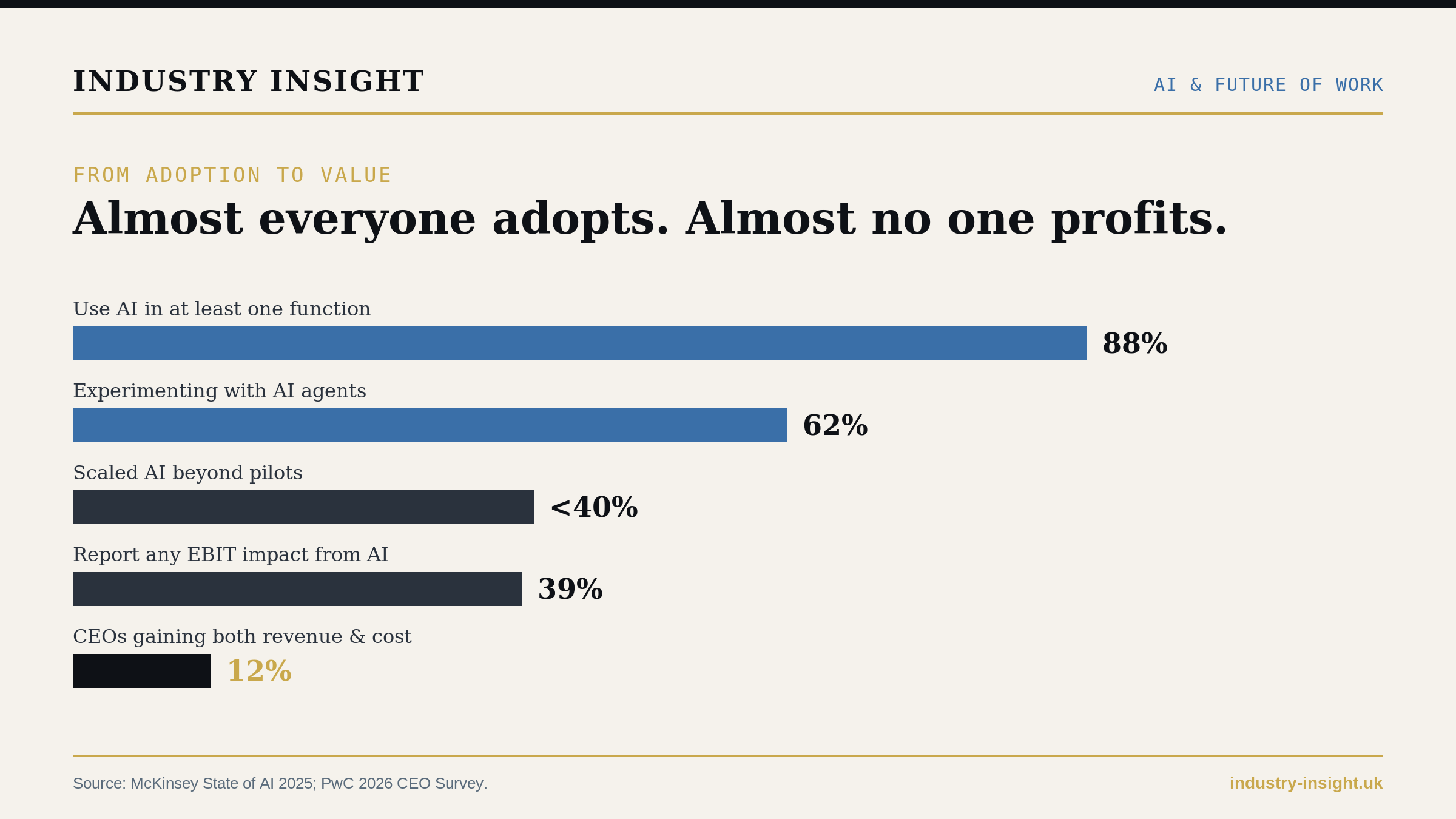
Figure 1. The drop-off from AI adoption to AI value (Source: McKinsey State of AI 2025; PwC 2026 CEO Survey).
The workforce reset
AI is rewriting the skill map as much as the org chart. The WEF expects 39% of core skills to be disrupted by 2030 and projects 78 million net new jobs — about 170 million created against 92 million displaced. AI fluency carries a wage premium today, but it is fading toward table stakes as it spreads. The durable advantage for individuals is judgment and learning velocity, which is the subject of our cluster The Career Moat.
Governing AI as it starts to act
As agents act autonomously, governance stops being an afterthought and becomes the constraint on safe scaling. Regulation is sharpening the point: the EU AI Act's Article 50 transparency duties land in August 2026, and the cost of getting governance wrong is rising. The organisations that scale agents successfully are not the ones with the fewest controls — they are the ones whose controls let them move with confidence.
What separates leaders from laggards
Across the data, the high performers share a profile — but the parts are not equal. Three of them are symptoms; one is the cause. Scaled agents, deliberate skills-building, and designed-in governance all follow from where accountability sits, and the data names the lever: high performers are three times more likely to have senior leaders who own the AI agenda. Ownership is upstream of everything else — even the fact that only 8% of managers are equipped to use AI well is a downstream consequence of who is accountable for closing that gap. Get ownership right, and the rest becomes reachable; leave AI delegated to IT, and no amount of tooling closes it.
What leaders should do now
Next 7 days. Map where AI is used against where it actually creates value, and name the gap honestly. If adoption is high and profit impact is low, that is the problem to solve — not more tools.
Next 30 days. Choose one or two functions to move from pilot to scaled, with skills and governance attached from the outset. Put a senior leader visibly on the hook for each.
Next 90 days. Treat AI as an operating-model program: leadership ownership, a skills plan, agent governance, and a value funnel you actually track — adoption rate, then scaled rate, then value-realised rate — so you manage the drop-off rather than just the activity. Revisit the org design as agents take on routine work.
Three boardroom questions
- Where has our AI adoption actually turned into profit — and where is it stuck at pilot?
- Do our senior leaders own the AI agenda, or has it been delegated to IT?
- Are we building the governance and skills to scale agents safely, or just buying tools?
Five strategic takeaways
- Stop measuring adoption; measure value. Nearly everyone uses AI — that is no longer a differentiator.
- Treat AI as an operating model change. Tools without new ways of working stall at the pilot.
- Put senior leaders on the hook. Ownership is the single biggest differentiator of high performers.
- Scale agents with governance built in. Controls are what let you move fast, not what slow you down.
- Invest in judgment and learning velocity. The durable workforce edge as specific skills churn.
Adoption was the easy part
The companies that win the AI era will not be the ones that adopted earliest or bought the most tools. They will be the ones that closed the gap between using AI and profiting from it — through leadership, skills, and governance. Adoption is nearly universal now. The advantage is still the work.
Explore the AI & Future of Work series
This pillar is built from focused, decision-ready clusters under AI & Future of Work:
More clusters publishing soon: Governing AI Agents · Why Most AI Pilots Fail · AI ROI: The Five Questions Executives Should Ask. (Hyperlink each from here as it goes live.)
FAQs
How many companies actually use AI? Around 88% use AI in at least one business function, per McKinsey's 2025 State of AI. But only about a third have scaled beyond pilots, and just 39% report any EBIT impact — adoption is widespread, value is not.
Why do most AI projects fail to deliver value? The constraint is usually leadership, skills, and operating-model change, not the technology. Only 12% of CEOs report both revenue gains and cost reductions from AI (PwC, 2026), and high performers are three times more likely to have senior-leader ownership.
What are AI agents? Systems that pursue a goal across multiple steps and tools — taking actions, not just generating answers. About 62% of organisations are experimenting with them, and 23% are scaling them (McKinsey, 2025).
Will AI cost jobs? The net picture is positive but churny: the WEF projects about 78 million net new jobs by 2030, with 39% of core skills disrupted. The risk is the transformation of roles, not the wholesale disappearance.
Sources: McKinsey State of AI 2025; PwC 2026 CEO Survey; WEF Future of Jobs 2025; Gartner (2025); IMF (AI exposure, 2024). Figures should be re-verified against the latest source at the time of publication.