

Data accurate as of 12 June 2026.
WHAT LEADERS NEED TO KNOW
The issue — Europe's digital rules (the DMA, DSA, AI Act, and the UK's DMCC) have moved from drafting to hard enforcement, and now into a sovereignty contest with Washington. The risk — fines reach 10% of global turnover (7% under the AI Act), and US retaliation threatens to pull firms into a transatlantic trade fight. The opportunity — firms that treat compliance as architecture (data, vendors, AI governance) turn a cost into a trust advantage and protected market access. The decision required — map your exposure across the DMA, AI Act, and data-sovereignty rules, and settle your cloud and data-residency posture now. The timeframe — the key duties land through 2026; the calendar is already running.
Europe spent five years writing the rulebook. In 2026, it started enforcing it
Europe has spent half a decade drafting the rules of the digital economy. This year, it began enforcing them — with teeth. For anyone tracking Global Economy & Policy, the shift is the story: the first Digital Markets Act fines have landed, the UK has designated Apple and Google as gatekeepers, and Brussels is now reaching into the cloud layer and into national-security-grade data. Read it as a European compliance footnote, and you will misread the decade. Digital regulation has become an industrial and geopolitical strategy.
Key signals
- First DMA fines landed — Apple was fined €500m and Meta €200m, the first penalties under the Digital Markets Act (European Commission, April 2025).
- The exposure ceiling is vast — the DMA alone caps fines at 10% of global turnover, so combined exposure across Apple, Google, Meta, Amazon, and Microsoft runs into the tens of billions of euros (Industry Insight analysis — an illustrative ceiling, not a Commission estimate).
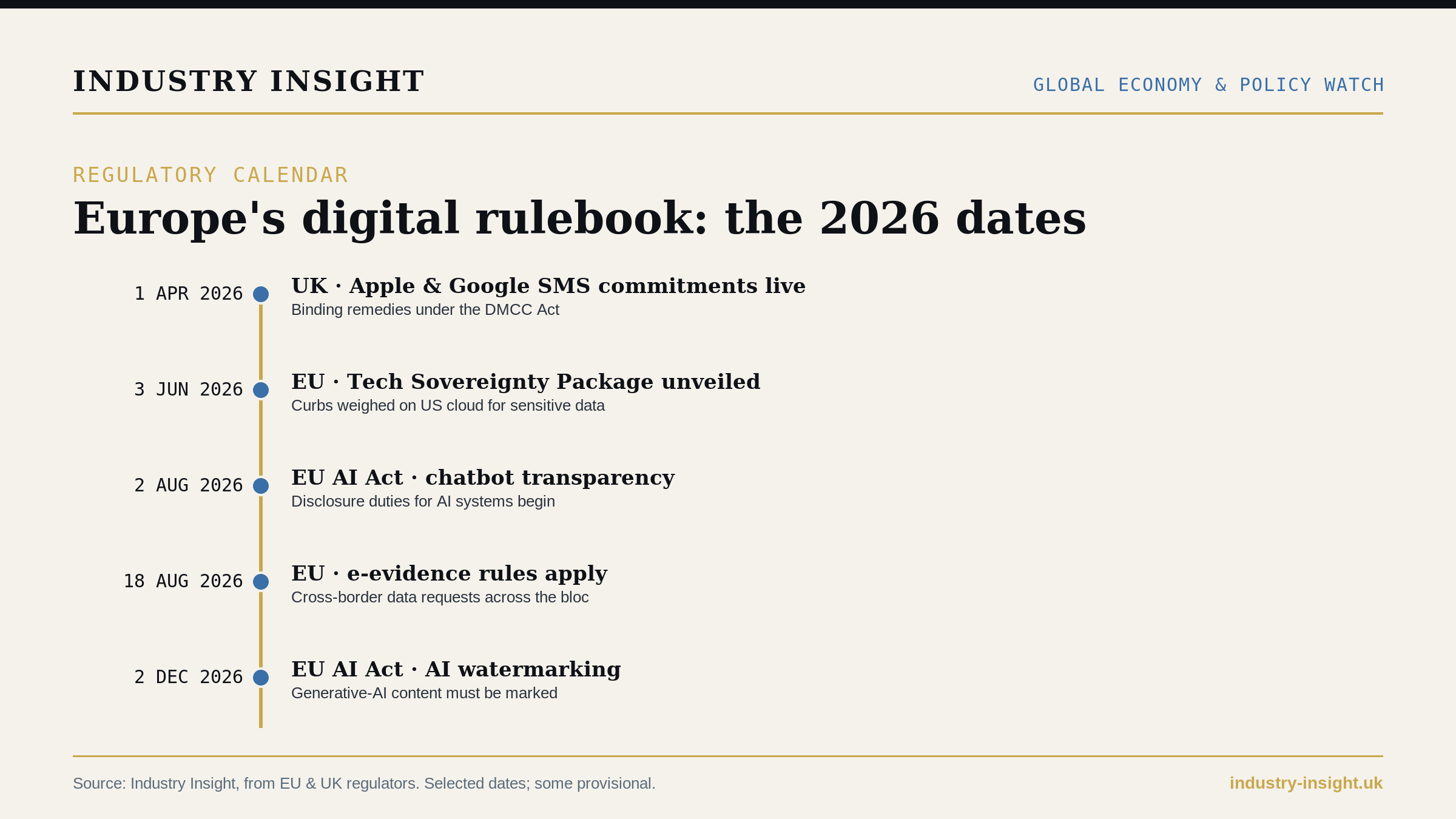
- The UK has its own gatekeeper regime — the CMA designated Apple and Google with Strategic Market Status in mobile platforms, an effective duopoly, the regulator says UK users cannot realistically escape, with binding commitments live since April 2026 (CMA / GOV.UK).
- Sovereignty is now policy — the EU is weighing curbs on US cloud providers for sensitive government, health, finance, and judicial data, with a Tech Sovereignty Package unveiled on 3 June 2026 (CNBC, 2026).
- Washington is pushing back — the US has threatened tariffs of up to 25% on EU tech and a Section 301 investigation, framing the rules as discriminatory against American firms (as reported, 2026).
What has changed
The rules stopped being future obligations and became live penalties. April 2025 brought the first DMA fines. Brussels then opened probes into Meta over blocking rival AI on WhatsApp and into Google over search and AI. Most tellingly, in late 2025, it opened cloud-market investigations into Amazon and Microsoft — pushing enforcement down into the infrastructure layer of the internet. The UK built a parallel regime under the DMCC Act: Strategic Market Status for Apple and Google, binding commitments from April 2026, and fines of up to 10% of global turnover. The AI Act adds yet another layer, with chatbot transparency duties from August 2026 and watermarking from December, even as its heaviest high-risk obligations were pushed back to 2027–28 under the EU's Digital Omnibus simplification package. The direction is one way: more enforcement, more surface area, more jurisdictions.
Why it matters
Two forces make this bigger than a compliance line item. The first is sovereignty. In 2025, Microsoft's French subsidiary confirmed under oath that it could not guarantee EU data against US authorities under the CLOUD Act, which turned "sovereign cloud" from a marketing phrase into a procurement policy. The EU is now moving to restrict US providers for sensitive sectors outright. For any business running on hyperscaler infrastructure in Europe, data residency and vendor choice have become board questions, not IT ones.
The second is geopolitics. Washington has threatened tariffs of up to 25% and a Section 301 case, casting the rules as discriminatory. If those threats are carried through, companies could be caught in the crossfire of what would be the largest transatlantic trade fight in years — not for anything they did, but for where their data sits and whose platform they depend on. Regulation has become a proxy for a wider contest over who governs the digital economy.
[[UPLOAD STAT CARD HERE — statcard-eu-digital-regulation-2026.png]] Figure 1. Europe's 2026 digital-regulation calendar (Source: Industry Insight, from EU & UK regulators; selected dates, some provisional).
Who is exposed
Far more than Big Tech. Any business that advertises on, sells through, or builds on the major platforms inherits the downstream effects of DMA remedies — changed app-store economics, limits on ad targeting, and new interoperability. Any business processing EU personal data or deploying customer-facing AI faces AI Act transparency duties on top of GDPR. Regulated sectors — health, finance, public services — face the sharpest data-residency pressure. And any multinational operating on both sides of the Atlantic must now plan for divergence, not harmonisation: two rulebooks, not one.
What leaders should do now
Next 7 days. Map exposure. List the platforms, clouds, and AI systems the business depends on, and which EU and UK rules touch each. Establish where your EU data physically sits and under whose legal jurisdiction it falls.
Next 30 days. Pressure-test your cloud and data-residency posture. Get written clarity from vendors on CLOUD Act exposure and sovereign options. Assign a named owner for AI Act readiness — chatbot transparency and watermarking — ahead of the August and December dates.
Next 90 days. Stand up a digital-regulation watch function. Treat compliance as architecture — data, vendors, and AI governance designed in, not bolted on. Scenario plan for transatlantic divergence in your contracts, pricing, and supply chain.
Three boardroom questions
- Where does our EU customer and operational data physically sit, and under whose legal reach?
- Which platforms and cloud providers are we single-threaded on, and what is our exposure if their terms change under DMA remedies?
- Are our customer-facing AI systems ready for the August and December 2026 AI Act duties, and who owns that?
Five strategic takeaways
- Treat compliance as architecture. Design data, vendors and AI governance in — don't bolt legal cleanup on at the end.
- Settle your data-residency posture now. Sovereignty has become a procurement decision, not a slide.
- Reduce single-vendor platform dependence. DMA remedies are opening switching options — use them.
- Stand up AI Act readiness ahead of the dates. Be ready before August and December, not on the day.
- Plan for two rulebooks. Assume transatlantic divergence and write it into contracts and scenarios.
The Brussels Effect, with teeth
The "Brussels Effect" used to mean the world quietly adopting Europe's rules. In 2026, it means something sharper: enforcement that bites, sovereignty as industrial policy, and an open transatlantic fight over who governs the digital economy. The firms that treat this as architecture will compound trust and protect their access. The ones that treat it as paperwork will discover the rules have already moved.
Related reading
Part of our guide to Global Economy & Policy:
FAQs
What are the penalties under the EU Digital Markets Act? Up to 10% of global annual turnover, rising to 20% for repeat breaches; the EU AI Act allows fines up to €35m or 7% of turnover. The first DMA fines, in April 2025, were €500m for Apple and €200m for Meta.
What is Strategic Market Status in the UK? Under the DMCC Act, the CMA can designate firms with entrenched market power. It designated Apple and Google in mobile platforms in October 2025, with binding commitments taking effect in April 2026.
Does the US CLOUD Act reach data stored in Europe? Yes. US providers can be compelled to hand over data even when it is stored in the EU; Microsoft's French unit confirmed this under oath in 2025. That is why data residency has become a board-level question.
What is the EU Tech Sovereignty Package? A set of measures, unveiled on 3 June 2026, aimed at reducing reliance on US cloud providers for sensitive data and backing European alternatives. Specifics are still developing and should be treated as provisional.
Sources: European Commission (DMA fines, April 2025); CMA / GOV.UK (Strategic Market Status, October 2025; commitments April 2026); CNBC, CNN,publication and Reuters (EU cloud sovereignty and transatlantic tensions, 2026); EU AI Act implementation timeline (2026). Items marked "as reported" or "provisional" are developing and should be re-verified at publish.