

Data accurate as of 18 June 2026.
WHAT LEADERS NEED TO KNOW
The issue — AI is commoditising technical knowledge and accelerating skill churn; in the jobs most exposed to AI, the skills employers ask for now change 66% faster than two years ago.
The risk — competing on the latest tool is a treadmill — you re-skill just to stand still.
The opportunity — a 56% wage premium attaches to AI-skilled roles today, and durable human skills — judgment, learning velocity, trust — compound into a defensible career moat.
The decision required — The timeframe; the skill map is resetting now; this is a 2026 priority, not a 2030 one.
The safest move in an AI economy is not learning the newest tool
The instinct in an AI economy is to chase the newest tool — and it quietly costs you the very advantage you are chasing. For anyone weighing the AI & Future of Work, the data is blunt: in the jobs most exposed to AI, the skills employers ask for are changing at 66% the rate they did two years ago. Compete on the hot skill of the moment, and you are on a treadmill. The durable advantage — the career moat — is built from what AI cannot commoditise: judgment, the ability to direct AI well, trust, and the speed at which you learn.
Key signals
- A skills reset is underway — 39% of core skills will be disrupted by 2030 (WEF, 2025).
- AI skills pay — for now — a 56% wage premium attaches to AI-skilled roles, up from 25% a year earlier (PwC, 2025).
- The half-life of a skill is collapsing — required skills change 66% faster in the occupations most exposed to AI, up from 25% a year earlier (PwC, 2025).
- Churn, not collapse — a projected 78 million net new jobs by 2030: about 170m created, 92m displaced (WEF, 2025).
- The credential is weakening — the share of AI-augmented jobs requiring a degree fell from 66% to 59% between 2019 and 2024 (PwC, 2025).
What is changing
The half-life of a skill is collapsing. PwC's analysis of nearly a billion job ads finds that skill requirements are changing 66% faster in occupations most exposed to AI; the WEF puts it at 39% of core skills disrupted by 2030. Here is the hinge most people miss: AI fluency is becoming table stakes, which is exactly why it commands a 56% premium today — and, in our analysis, exactly why that premium will compress as fluency becomes universal. Fluency is a floor to clear quickly, not a moat to live on. At the same time, the credential is weakening: employers are dropping degree requirements fastest for the very jobs AI touches. The market is repricing what it values — away from what you know, toward the judgment you bring and how fast you learn.
Why it matters
For individuals, competing on perishable, tool-specific skills is a losing game: you re-skill every few months just to keep pace, and the moment a tool goes mainstream, your edge evaporates. The compounding advantage lies in meta-skills — judgment (deciding what is worth doing and whether the AI's output is actually right), learning velocity (acquiring the next capability faster than your peers), the ability to orchestrate AI, and the trust and relationships that no model holds. These are the bricks of a career moat: unlike a tool, they deepen with time.
For leaders, the talent strategy that wins is not hiring for today's hot skill; it is building people who learn fast and exercise judgment, and designing work so that humans do the judging and machines do the rote. The 56% premium is a useful signal, but a fading one. Pay for adaptability, not for a tool that will be obsolete by the next budget cycle.
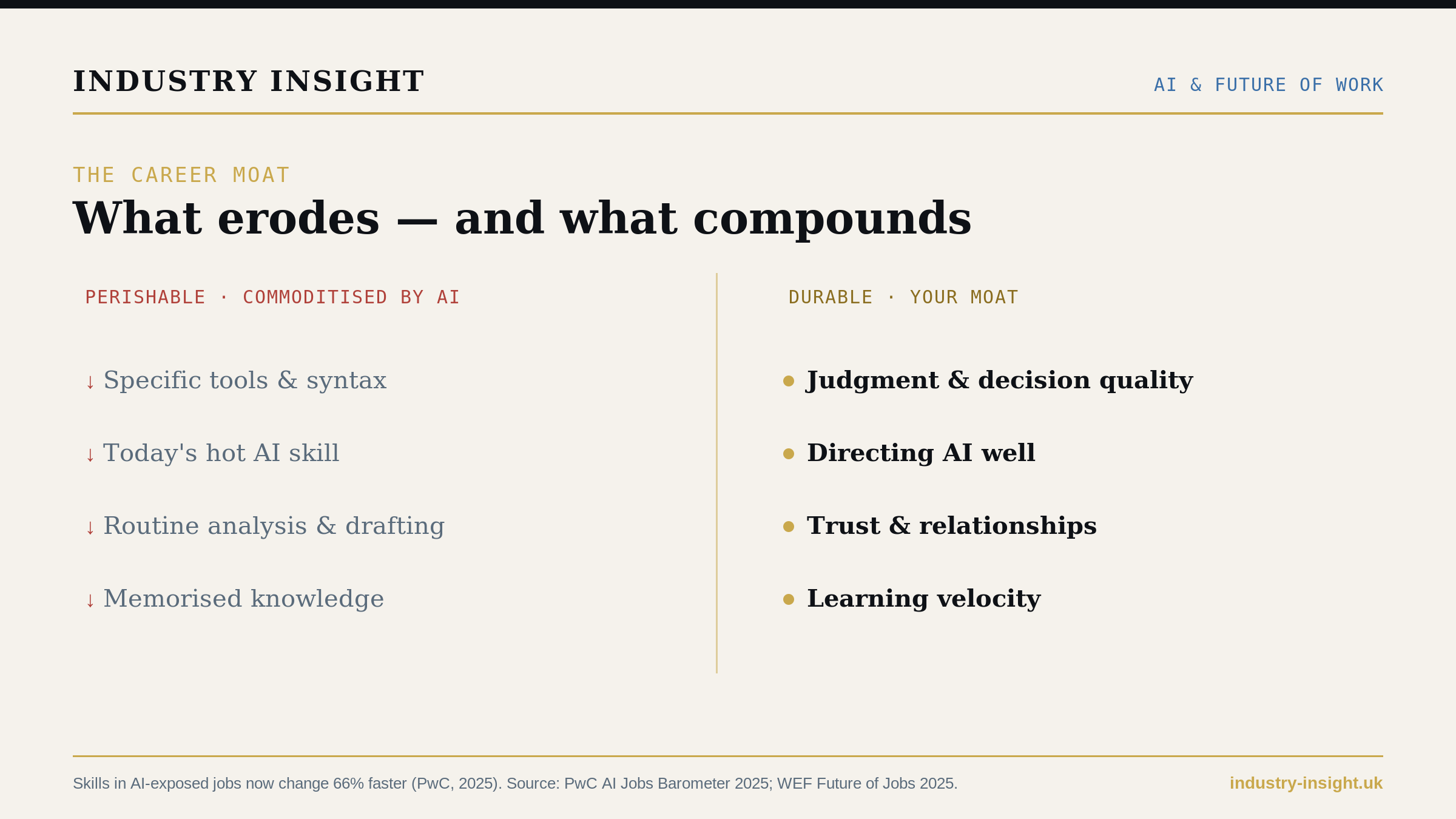
Figure 1. The career moat: what AI commoditises versus what compounds (Source: PwC AI Jobs Barometer 2025; WEF Future of Jobs 2025).
Who is exposed — and who pulls ahead
The IMF's January 2024 analysis put 40% of jobs globally at risk of exposure to AI, rising to 60% in advanced economies. Knowledge workers — analysts, marketers, lawyers, developers, finance professionals — are both the most exposed and the best placed to benefit. The people who pull ahead are not the most technical; they are the ones who pair domain judgment with AI fluency. The people who fall behind treat AI as either a threat to ignore or a magic button to trust blindly. Neither builds a moat.
What leaders and ambitious professionals should do now
Next 7 days. Audit your own skill mix and split it into two: the perishable (tools, syntax, today's hot technique) and the durable (judgment, communication, learning). Get fluent enough in one AI tool to clear the floor — then stop chasing tools and pour your effort into one durable skill to compound.
Next 30 days. Build AI into real work where you can judge the output, not just generate it. For teams: stop training on tools alone and start coaching judgment and how to direct AI well.
Next 90 days. Make learning a system, not an event — a deliberate cadence of skill-building. For leaders: redesign roles so humans own judgment, relationships, and exceptions, and make adaptability something you actually measure in reviews.
Three boardroom questions
- Are we developing people for today's hot skills, or for learning velocity and judgment?
- Where in our work should a human make the decision, and where should AI take the routine?
- How do we identify and retain the people who pair domain judgment with AI fluency — before competitors do?
Five strategic takeaways
- Build the moat, not the skill. Invest in judgment, learning velocity, trust, and AI orchestration.
- Treat AI fluency as table stakes. Necessary, not sufficient — the premium will fade as it spreads.
- Compound, don't cram. A weekly learning habit beats annual training when a skill's half-life is months.
- Redesign work: humans judge, machines do the rote. Put people where their judgment compounds.
- Hire and promote for adaptability over credentials. The degree signal is weakening; demonstrated capability is not.
The only edge that compounds
The newest skill is depreciating the day you learn it. The moat is the capacity to keep learning, to judge well, and to be trusted — and that only deepens with time. In an economy where AI redraws the skill map every year, the most future-proof thing you can be is someone who adapts faster than the map changes.
Related reading
Part of our guide to AI & Future of Work:
FAQs
Will AI replace my job? The WEF projects 92 million roles displaced but 170 million created by 2030 — a net gain, but with heavy churn. The bigger risk is transformation, not disappearance: 39% of core skills are set to change by 2030, so the job you keep will not look the same.
Which skills are most future-proof? WEF's data points to analytical thinking (the single most-sought skill), resilience, leadership, collaboration, and curiosity, paired with AI fluency. The durable advantage is judgment and learning velocity, not any one tool.
Is it worth learning AI skills if they change so fast? Yes — AI-skilled roles carry a 56% wage premium today. But treat fluency as table stakes; the lasting return is in learning how to learn and applying judgment, because the specific tools will keep changing.
Do degrees still matter? Less, for AI-exposed work: the share of AI-augmented jobs requiring a degree fell from 66% to 59%, per PwC. Demonstrated capability and adaptability increasingly outweigh the credentials.
Sources: WEF Future of Jobs Report 2025; PwC 2025 Global AI Jobs Barometer; IMF analysis of AI exposure (January 2024). Figures should be re-verified against the latest source at the time of publication.