

Data accurate as of 17 June 2026.
WHAT LEADERS NEED TO KNOW
The issue — AI is commoditising technical expertise, so the scarce leadership skills are now human — judgment, empathy, trust — yet most managers are not equipped for the AI-era version of the job.
The risk — only 8% of HR leaders believe their managers can use AI effectively, and burnout and change fatigue are rising; leadership capability, not technology, is the binding constraint.
The opportunity — leaders who pair AI fluency with emotional intelligence — the “human + AI” leader — become the scarce, decisive asset.
The decision required developing judgment, empathy, and AI fluency together, and measuring leaders on trust and people outcomes, not output alone.
The timeframe — leader development has topped HR priorities for years; the capability gap is widening now.
As AI commoditises expertise, the human part becomes the whole job
For years, emotional intelligence was filed under "nice to have." That filing is now a commercial mistake. Leadership & Decision Frameworks Daniel Goleman tied emotional intelligence to superior leadership performance back in 1998. The difference now is scarcity — AI has made the technical half of the job cheap, and the human half decisive. Yet most leadership development still treats empathy as a soft add-on, when it has become the operational core of leading an AI-augmented team.
Key signals
- Leadership development is the top priority — leader and manager development has been HR leaders' number-one priority for three consecutive years, and again in 2026 (Gartner).
- The capability gap is stark — just 8% of HR leaders believe their managers have the skills to use AI effectively (Gartner, 2025).
- The model is shifting to human + AI — 2026's defining leadership trend is blending machine efficiency with human judgment, empathy, and context (DDI, 2026).
- AI value is stalling on people, not tech — 88% of HR leaders say their organisation has not yet realised significant business value from AI tools (Gartner, 2025).
- The failure mode is human — burnout and “change fatigue” are top concerns, with CHROs redefining leader expectations around sustaining people through constant change (Gartner, 2026).
What is changing
The value of so-called soft skills is hardening. As AI commoditises technical knowledge, scarcity shifts to what it cannot replicate: reading a room, holding trust, and making the judgment call when the data runs out. This is not a rejection of technology — the leaders who win are fluent with AI. But fluency is now table stakes. The differentiator sits one level up, in the distinctly human work of leadership — which makes “soft skills” an expensive misnomer.
Why it matters
The evidence that the bottleneck is human is mounting. Leader and manager development has topped HR priorities for years; only 8% of HR leaders think their managers can use AI effectively, and 88% say their organisations have not yet seen significant business value from AI tools. Read those together: the technology is largely in place; the leadership to turn it into results is not. The dominant 2026 failure mode is human — change fatigue, burnout, quiet disengagement. In our analysis, a technically capable leader who cannot carry people through change caps the return on every AI investment beneath them, while one who can also direct AI compounds it. That asymmetry is the whole case.
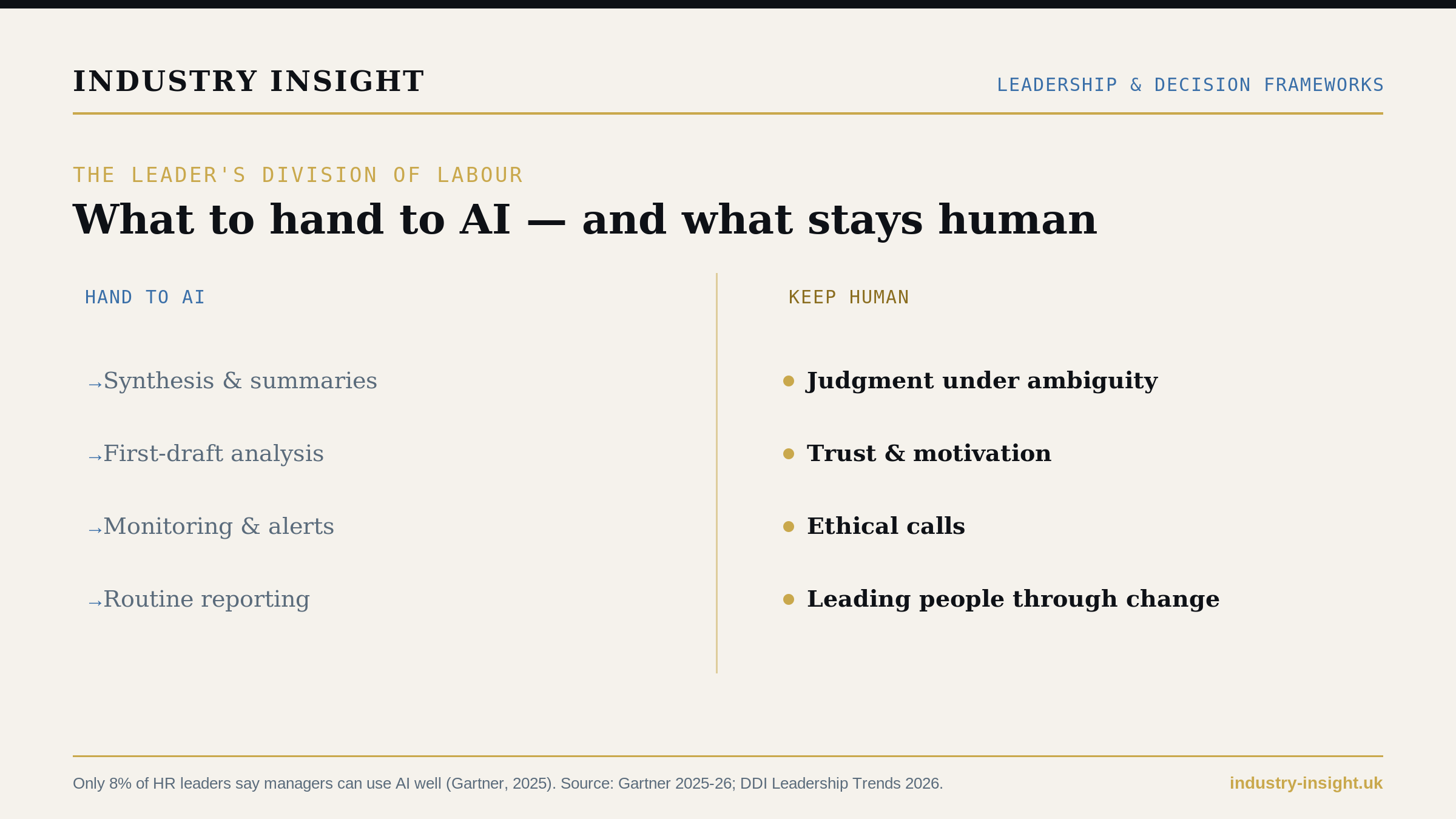
Figure 1. The leader's division of labour — what to delegate to AI, and what stays distinctly human (Source: Gartner 2025–26; DDI Leadership Trends 2026).
A decision framework: where the human edge applies
The practical question is not “is EQ important?” but “where, exactly, should a leader spend their human capital?” The division of labour above is the framework. Hand to AI the work it does well and tirelessly: synthesis, first-draft analysis, monitoring, routine reporting. Reserve for humans the four things that decide outcomes and that AI cannot own — judgment under ambiguity, trust and motivation, ethical calls, and leading people through change. The leader's job is to move as much of their own time as possible from the left column to the right.
Who is exposed
Middle managers most of all. They are being asked to adopt AI, hit targets, and hold teams together through constant change — usually without training for any of it, which is why the 8% figure is so striking. Senior leaders are exposed through them: a leadership tier that cannot pair AI fluency with human judgment caps the value of every AI investment beneath it. And the organisations most at risk are those still developing leaders the old way — technical and functional training, with the human capabilities left to chance.
What leaders should do now
Next 7 days. Audit where you and your managers actually spend time, and sort it into the two columns above. Name the handful of human calls — the trust, judgment, and change decisions — that only a leader should make, and protect time for them.
Next 30 days. Pair AI fluency with emotional intelligence in development. Train managers both to use AI well and to lead people through the change it brings — not one without the other. Give them approved tools and coaching on judgment, not just access.
Next 90 days. Redefine what you expect of leaders and how you measure them: include judgment, trust-building, and change leadership, not output alone. Deliberately build manager capacity to reduce burnout, because change fatigue is now a performance risk, not a wellbeing footnote.
Three boardroom questions
- Is our leadership development building AI fluency and human judgment together, or technical training alone?
- Where are our managers making the human calls — trust, motivation, change — and are we equipping them for it?
- How are we measuring, and protecting against, burnout and change fatigue in our leaders?
Five strategic takeaways
- Treat "soft" as a hard skill. Judgment, empathy, and trust are now the scarce leadership edge.
- The constraint is leadership, not technology. AI value is capped by leaders who can pair fluency with judgment.
- Develop AI fluency and EQ together. Build the "human + AI" leader, not one half of one.
- Treat burnout as a performance risk. Change fatigue is the 2026 failure mode — manage it deliberately.
- Measure leaders on trust and judgment. Not output alone — what you measure is what you build.
The hardest, most durable edge
The AI era does not make leadership less human; it makes the human part of the whole job. The leaders who win the next decade will not be the most technically skilled. They will be the ones who pair fluent use of AI with the judgment, empathy, and trust no model can replicate. That is not a soft advantage. It is the hardest and most durable edge a leader can hold.
Related reading
Part of our guide to Leadership & Decision Frameworks:
FAQs
Does emotional intelligence really affect business performance? Foundational research by Daniel Goleman links emotional intelligence to superior leadership performance, and current data reinforces it: human-centered leadership is a top 2026 trend, and leader development has been HR's number-one priority for years (Gartner, DDI). As AI commoditises technical skill, the human premium is widening.
Will AI replace managers? Unlikely — but it is changing the job. Only 8% of HR leaders think managers can use AI well today, so the real risk is managers who cannot adapt, not the role disappearing.
What is the most important leadership skill in the AI era? The pairing: AI fluency plus human judgment, empathy, and the ability to lead people through change. Either on its own is now insufficient.
Can emotional intelligence be developed? Yes — treat it as trainable. Coach judgment, feedback, and change leadership alongside AI fluency, and measure leaders on trust and people outcomes, not output alone.
Sources: Gartner (leader and manager development priority; 8% of managers AI-skilled; 88% no significant AI value yet; 2026 CHRO priorities, 2025–26); DDI Leadership Trends 2026; WEF Future of Jobs 2025; foundational emotional-intelligence research (Goleman, 1998). Figures should be re-verified against the latest source at the time of publication.