

Data accurate as of 11 June 2026.
WHAT LEADERS NEED TO KNOW
The issue — the Strait of Hormuz has been all but closed since early March 2026. It normally carries about a fifth of the world's oil. The risk — a sustained oil price near or above $100 keeps inflation high and the cost of capital higher for longer. The opportunity — firms that price resilience now win share from competitors caught flat-footed on energy and freight. The decision required — re-underwrite the year at $100–125 oil and remove single-source energy, LNG, and shipping dependencies. The timeframe — act this quarter; the disruption is now measured in months, not days.
The waterway is now setting the price of doing business
One contested waterway now helps set the price of doing business. Roughly 20 million barrels of oil a day — about a fifth of global consumption — normally move through the Strait of Hormuz. Since early March 2026 it has been all but closed, and the US–Israel–Iran conflict that triggered the shutdown shows little sign of resolving. For anyone tracking Global Economy & Policy, this is the defining macro risk of the year. Brent has settled near $93–105, the IMF has cut its global growth forecast, and the disruption has already reordered shipping, inflation, and the cost of capital. Treating it as a foreign news story is an expensive mistake.
Key signals
- The largest oil supply shock on record — the initial disruption removed about 10 million barrels a day from global supply (IEA, April 2026).
- Growth downgraded — the IMF cut its 2026 global growth forecast to 3.1%, from 3.4% before the war, and raised projected inflation to 4.4% (IMF, April 2026).
- A fifth of global LNG is ,gone — QatarEnergy's force majeure through March pulled roughly 20% of global LNG supply off the market.
- Freight repricing — very large crude carrier rates on the Gulf–China route spiked 94% to a record $423,736 a day; the Cape reroute adds 10–14 days a voyage.
- No easy bypass — existing pipelines can carry only about 2.6 million barrels a day against some 20 million normally routed through Hormuz, leaving close to 90% of flows with no overland alternative.
What happened
The conflict between the United States, Israel, and Iran began in late February 2026. On 4 March, Iran declared the Strait of Hormuz closed and threatened any vessel attempting passage, and QatarEnergy declared force majeure on LNG cargoes within days, widening it across long-term contracts by late March. A ceasefire in April briefly raised hopes. It has since unravelled, with renewed strikes on shipping into early June. Limited volumes are now trickling out of the Gulf, but the strait remains effectively shut to commercial traffic. Brent, which spiked toward $120 at the outset, has settled into a $93–105 band as markets price a long, contained disruption rather than a short, total one.
Why it matters
The Strait is not one risk among many; it is the single most important oil chokepoint on earth. In recent years, it has carried about 20 million barrels a day — roughly a fifth of global petroleum liquids consumption and about a quarter of all seaborne oil trade (U.S. EIA). That concentration is why a single blockade moves world prices.
The IMF's April outlook is blunt about the stakes. Hold oil near $100 through 2026, and global growth slows to 2.5%, with inflation at 5.4%. Let the disruption persist near $110 into 2027, and growth falls to about 2%, inflation pushes toward 6%, and the Fund warns of "a close call for a global recession." The pump price is only the visible part. The deeper effect runs through inflation, which complicates the rate cuts markets had been counting on, and so through the cost of capital. For most businesses, higher-for-longer financing will matter more than the fuel bill.
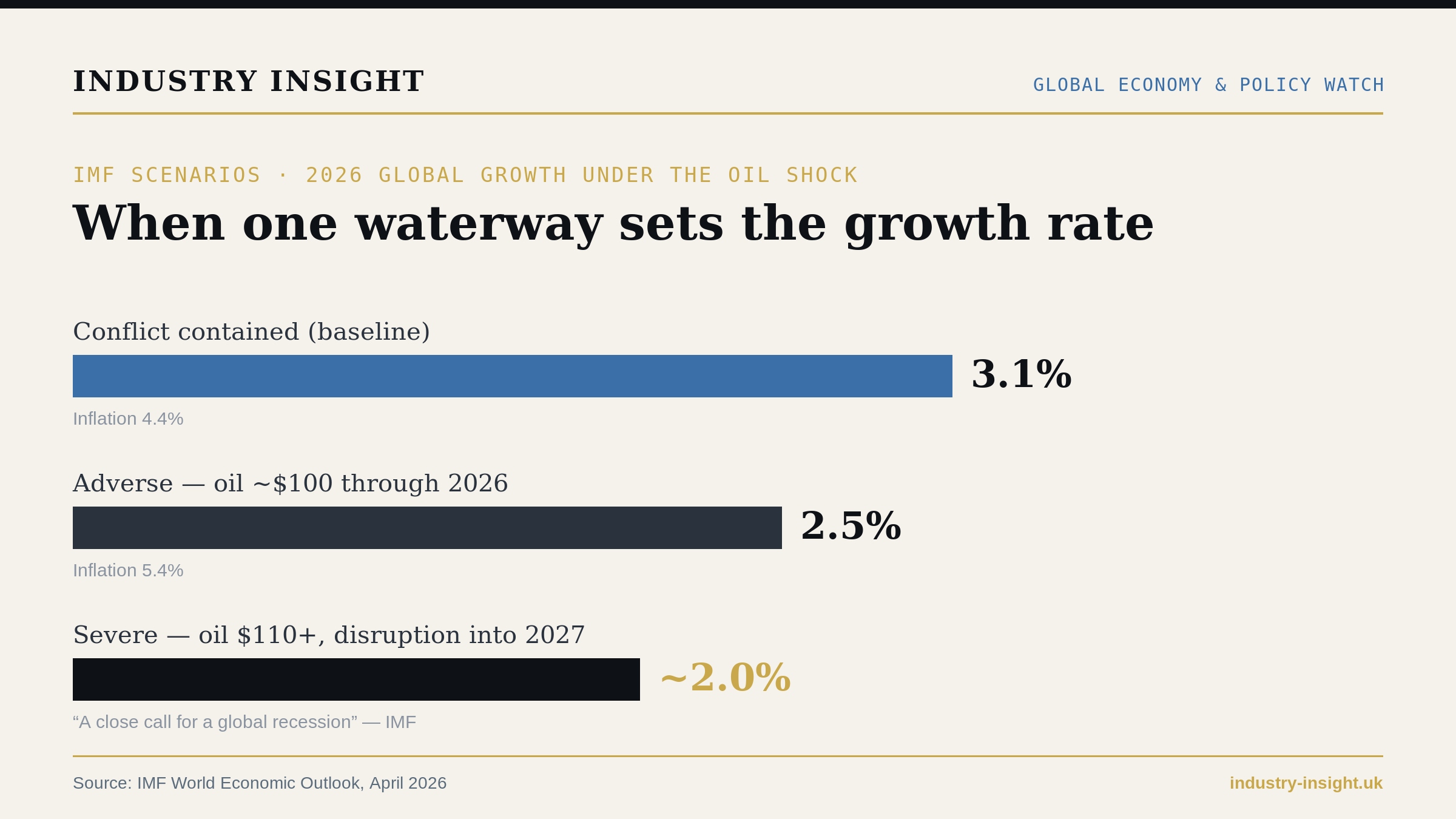
Figure 1. The IMF's 2026 growth scenarios under the oil shock (Source: IMF World Economic Outlook, April 2026).
Who is exposed
The exposure is far wider than energy producers. Energy-intensive manufacturers, chemical companies, airlines, and logistics operators feel it directly through fuel and power costs. Asian LNG importers are acutely vulnerable: India sources a large share of its gas from Qatar and the UAE, and Qatar and the UAE supply almost all of Pakistan's LNG and most of Bangladesh's, with limited storage to absorb a shock. Anyone with Gulf-routed supply chains faces a 10–14-day Cape detour and record freight rates. And every business carrying floating-rate debt or planning capital investment is exposed to the second-order hit: a cost of capital that no longer falls on the schedule the market assumed six months ago.
What leaders should do now
Next 7 days. Quantify direct and indirect energy exposure and model the P&L at Brent prices of $100 and $125. Pull every contract with fuel surcharge or force majeure clauses. Brief the board on the worst-case scenario before it arrives, not after.
Next 30 days. Stress-test supply chains for the Cape reroute and rebuild inventory buffers on Gulf-routed inputs. Lock hedges where the forward curve allows, and revisit pricing to pass through input costs. Re-examine any capital plan that assumed cheaper financing in the second half of 2026.
Next 90 days. Diversify single-source energy and LNG dependencies, renegotiate logistics contracts for routing flexibility, and stand up a standing geopolitical early-warning function so the business reads risk ahead of the headlines rather than chasing them.
Three boardroom questions
- What is our P&L exposure if Brent holds at $110 and the cost of capital stays higher for the rest of 2026?
- Where are we single-threaded on Gulf-routed energy, LNG, or freight, and what does a credible second source cost?
- Which pricing, hedging, and inventory levers can we actually pull this quarter, and who owns each one?
Five strategic takeaways
- Re-underwrite the year. Rebuild budgets and covenants on a $100–125 oil band, not the pre-war base case.
- Treat the cost of capital as the primary risk. The financing effect will outlast the oil spike and reach further into the business.
- Pay for optionality in logistics. Routing flexibility and buffer stock are cheap relative to a halted line.
- Pass through what you can, hedge what you can't. Decide now where pricing power ends, and hedging begins.
- Institutionalise early warning. Make geopolitical risk a standing board variable, not a quarterly surprise.
The next chokepoint is closer than it looks
Energy shocks end; the strategic lesson does not. The firms that come through 2026 in good shape will be the ones that treated a single contested waterway as a board-level variable, not a news item, and priced resilience before they were forced to. Hormuz will reopen. Bab-el-Mandeb, Malacca, and the Taiwan Strait will not have moved — and neither will the lesson.
Related reading
Part of our guide to Global Economy & Policy:
FAQs
How much oil passes through the Strait of Hormuz? About 20 million barrels a day in recent years — roughly a fifth of global petroleum liquids consumption and about a quarter of all seaborne oil trade, according to the U.S. EIA. That concentration is why one chokepoint can move world prices.
What is the current Brent crude price? As of 11 June 2026, Brent is trading in roughly the $93–105 range, down from a spike toward $120 at the outset of the conflict. The IMF's planning assumptions cluster around $100–105 for mid-2026.
Could this tip the world into recession? The IMF's severe scenario — disruption persisting near $110 oil into 2027 — would slow global growth to about 2%, which it describes as a close call for a global recession. It is a live risk, not yet the base case.
What should businesses do right now? Model the P&L at $100 and $125 oil, identify single-source energy and freight dependencies, secure hedges and routing flexibility, and reassess any capex that assumed cheaper financing.
Sources: IMF World Economic Outlook (April 2026); IEA Oil Market Report (April 2026); U.S. EIA, Strait of Hormuz chokepoint analysis (2025); World Bank Commodity Markets Outlook (April 2026); EIA Short-Term Energy Outlook & Trading Economics (June 2026).